.webp)
Disability means so many things, and so many different lived experiences. Mobility impairment, acquired brain injury, autism, degenerative neurological conditions, complex behavioural needs. Each person’s functional profile is unique.
Trying to design a home that accommodates every possible disability outcome is inefficient and often ineffective. Good purpose-built disability housing starts with clarity: who is this for, what do they need to live well, and how will this building support that day after day?
For providers entering or scaling within Specialist Disability Accommodation (SDA), that clarity is the foundation of successful SDA project delivery.
What is Specialist Disability Accommodation (SDA)?
Specialist Disability Accommodation (SDA) sits within the National Disability Insurance Scheme (NDIS) and is designed for participants with extreme functional impairment or very high support needs who require specialist housing solutions.
Under NDIS SDA funding, eligible participants receive funding for the housing component of their support plan, based on approved SDA design categories such as High Physical Support, Fully Accessible, Improved Liveability and Robust.
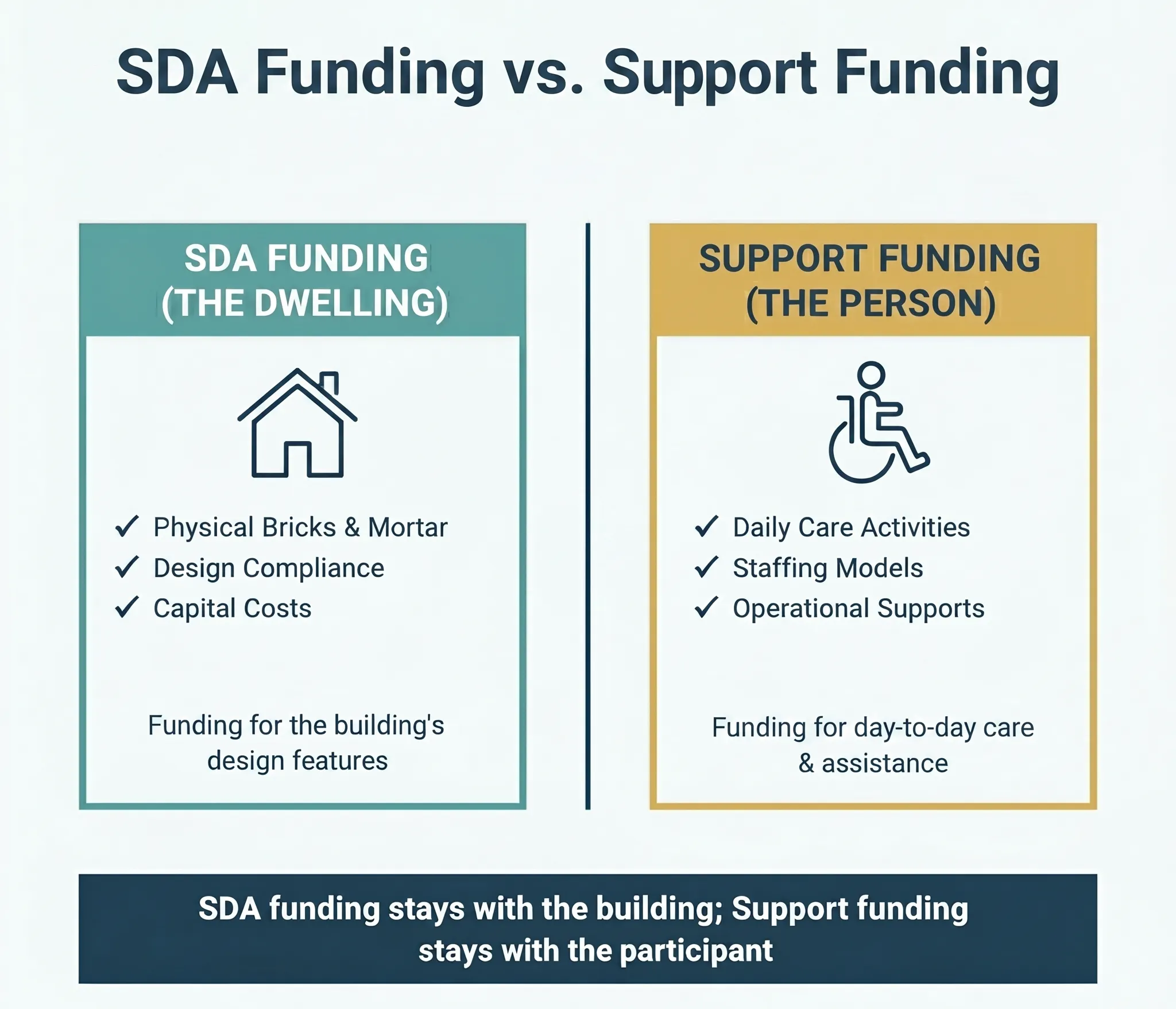
The funding relates to the dwelling itself, that is, its design features and compliance with SDA requirements, rather than the day-to-day care supports delivered within it.
This distinction matters. SDA is not general accessible housing. It is regulated, performance-based housing aligned to specific functional needs and governed by the SDA Design Standards Australia framework.
The current landscape: SDA demand and supply in Australia
The SDA market has matured significantly since the NDIS rollout. There are now more than 100 for-profit and not-for-profit organisations engaged in SDA housing development, and private capital has increasingly entered the sector.
Research from the Australian Housing and Urban Research Institute (AHURI) highlights a key insight: capital availability is strong; but clarity around participant demand, geographic distribution and assessment processes remains essential for large-scale investment to be realised. In other words, the challenge is not simply building more homes - it is ensuring the right homes are built, in the right places, for the right participants.
Understanding SDA demand and supply in Australia is therefore a feasibility issue as much as a social one. A mismatch between design category and participant need can slow occupancy, have an impact on revenue modelling and introduce unnecessary risk.
How NDIS SDA funding shapes what you build
NDIS SDA funding operates through participant-specific allocations. A participant must be formally assessed as eligible for SDA, and their approved NDIS plan specifies both their SDA eligibility and the design category (for example, High Physical Support or Robust) that reflects their functional needs.
For providers, this has direct implications:
- Financial modelling must align with the SDA design category attached to participants’ approved plans.
- Compliance must align with SDA design standards.
- Location planning must reflect participant pipeline.
- Occupancy certainty depends on accurate needs assessment.
Successful SDA feasibility and planning begins upstream, before design drawings are finalised and before sites are secured.
Clarity around participant profile informs everything from dwelling configuration to assistive technology integration and operational staffing models.
How do you know what to build?
This is the core question in any SDA housing development.
The answer lies in aligning design with evidence and lived experience.
1. Start with demand data
Engage with Local Area Coordinators, support coordinators and planners to understand the functional profiles of participants in your target region. Are mobility needs dominant? Is there demand for Robust housing? Is there an emerging need for Improved Liveability dwellings for neurodivergent participants?
Clear demand mapping strengthens early feasibility assumptions.
2. Understand the SDA design categories
The SDA Design Standards Australia framework outlines performance expectations for each category.
- High Physical Support dwellings require structural provisions for ceiling hoists, assistive technology readiness and backup power systems.
- Fully Accessible dwellings focus on circulation, transfer space and step-free access.
- Improved Liveability supports sensory, cognitive and communication needs through spatial layout and environmental controls.
- Robust housing incorporates durability and safety-oriented design elements.
Each dwelling has distinct capital costs and operational implications.
3. Engage participants and support teams
A wheelchair-accessible bathroom is one part of mobility-focused design. A predictable layout, low-stimulus environment or clearly defined private zones may be critical for participants with acquired brain injury or autism spectrum conditions.
Design decisions become stronger when participant experience informs them early.
Similarly, we’ve delved into how ‘building for dignity’ elevates aged care project delivery in this blog.
4. Integrate operational thinking
SDA operational planning often determines long-term viability.
Support worker workflows, overnight assistance models, maintenance access and technology servicing all influence layout and systems planning.
Homes that function well operationally improve participant outcomes and provider sustainability.
What does good SDA design look like in practice?
Effective purpose-built disability housing is shaped by clearly defined functional requirements and the everyday realities of the people who will live there.
For high physical support participants, this may include reinforced ceilings for hoist systems, accessible kitchen joinery and automated environmental controls.
For cognitive and sensory needs, spatial legibility, acoustic management, natural light control and quiet retreat spaces become essential.
For participants requiring robust environments, material durability and safety detailing are central considerations.
Design compliance under the SDA standards is necessary. Design empathy elevates the outcome.
Delivery certainty: The three pillars that reduce risk
Many of the risks in SDA project delivery originate before construction begins. Building in locations without verified participant demand, misjudging design category requirements or overlooking operational implications can introduce avoidable uncertainty.
Creating certainty in disability housing delivery rests on three interconnected pillars:
- Demand clarity: Understanding who will occupy the dwelling
- Design alignment: Meeting SDA standards while responding to participant needs
- Operational readiness: Ensuring the dwelling works in practice
When these pillars are addressed early, providers are better positioned for smoother approvals, stronger financial modelling and more predictable project outcomes. This is where reducing SDA delivery risk becomes tangible rather than theoretical.
At MakeSpace, our role in SDA housing development is to help providers structure projects around these three pillars. By combining demand insight, technical coordination and operational foresight, we support more confident decision-making from feasibility through to delivery.
Specialist Disability Accommodation holds enormous potential - socially and commercially - when projects are grounded in clarity. Homes that endure are those shaped by evidence, empathy and disciplined planning working together.
If you are considering your next SDA project delivery, starting with the right foundations will determine everything that follows.
Get in touch
Ready to deliver housing that makes a real difference? We'd love to discuss your project.


