
If you’re prepping for funding approval, check out our blog that breaks down what your business case should have to secure funding.
Securing funding approval for a housing project is a major milestone.
But once funding is approved, the real work of delivery begins.
Housing developments typically move through a structured housing development project lifecycle before reaching completion. While each project is unique, most follow a similar sequence of housing project delivery phases that take a project from concept to a functioning building.
Across Australia, project delivery frameworks used in infrastructure and housing development emphasise the importance of strong governance and risk management throughout this lifecycle. Organisations such as Infrastructure Australia consistently highlight that early planning, clear project governance and proactive risk management are critical to successful delivery.
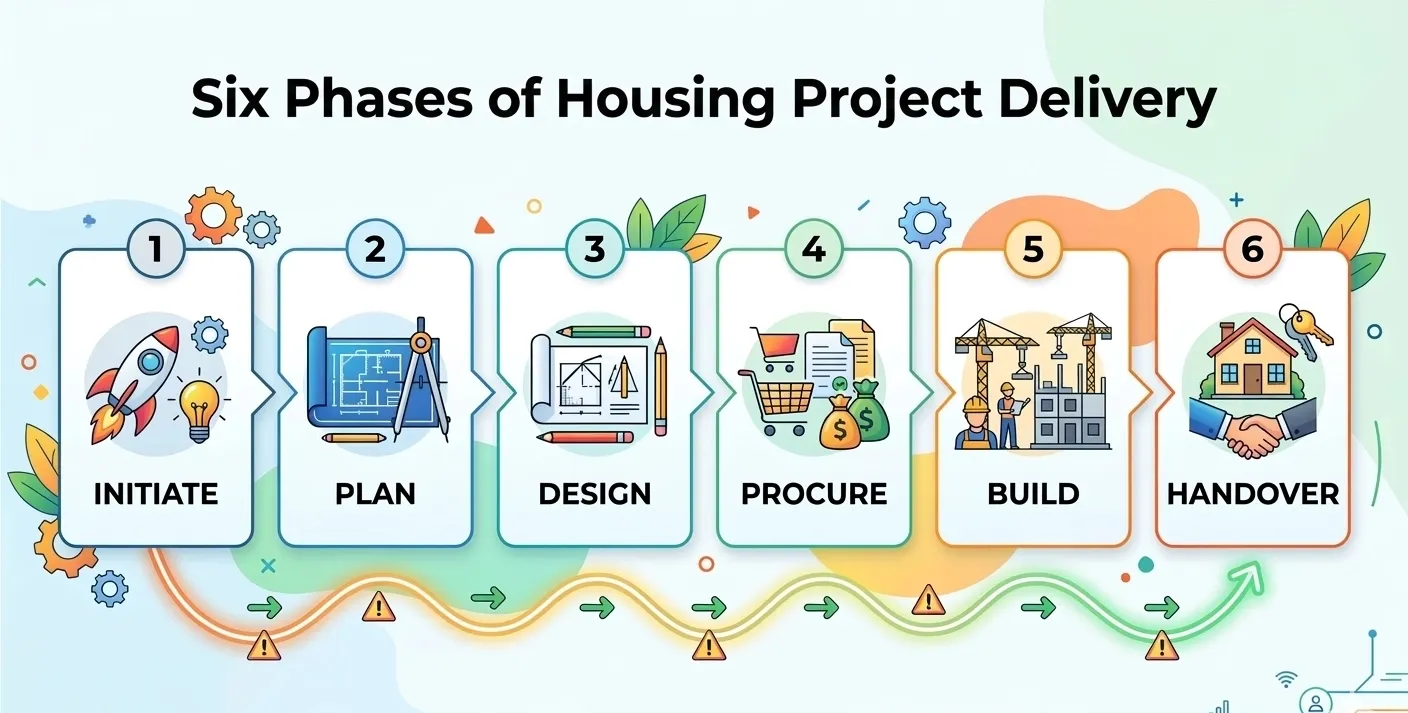
Understanding what can go wrong at each stage, and how to prevent it, is one of the most effective ways of managing delivery risk in housing projects and improving housing project delivery certainty.
Phase 1: Initiate - are the objectives truly clear?
The initiation phase kicks off the project delivery.
At this stage, the focus is on understanding the project before detailed work begins.
This usually means reviewing the project brief, funding approval documentation, or business case that justified the development in the first place.
The most important question to answer early is:
Do we clearly understand what the client actually wants?
This involves clarifying:
- The project scope
- The intended outcomes
- The priorities that cannot be compromised.
Different housing sectors place different emphasis on project outcomes.
For example:
- In aged care, resident safety and wellbeing may be the absolute priority.
- In student accommodation, protecting student experience during construction may take precedence.
- In operational environments such as hospitals, disruption, noise and dust may be tightly controlled.
Understanding how these priorities rank is essential.
Some objectives inevitably compete with others. A faster delivery program may increase cost. A higher design specification may impact feasibility.
The initiation phase is where these trade-offs must be understood so the project team can align around the same objectives from the start.
Phase 2: Plan - setting the project up for success
Once the objectives are clear, the project moves into the planning phase.
If initiation is about understanding the project, planning is about setting the housing project delivery up in a way that can actually achieve those objectives.
This phase focuses on building the framework that will guide the project through the rest of the lifecycle.
Key considerations during housing project planning and design preparation typically include:
- Selecting the appropriate delivery strategy
- Establishing project governance structures
- Developing the project program
- Setting early cost planning and budgets
- Identifying key approvals and regulatory requirements
Strong early planning significantly improves housing project delivery certainty.
Without it, projects often run into issues later when timelines, budgets and responsibilities have not been clearly defined.
Planning is also where early housing project risk management begins, identifying the potential issues that could affect the project before design and construction start.
Phase 3: Design - one objective shouldn’t break another
Design is where the project starts to take shape.
One of the most important decisions at this stage is assembling the right design team.
For specialised sectors such as aged care, retirement living or specialist disability accommodation, experience matters. Teams that have delivered similar projects are more likely to anticipate operational requirements, regulatory standards and design constraints.
A common issue during housing project planning and design is when one objective begins to dominate the process.
For example:
- A design may satisfy the brief but exceed the construction budget.
- Layouts may look impressive but prove inefficient or expensive to build.
- Rooms may technically meet the scope but fail to meet operational requirements.
Another common failure point occurs when pricing feedback comes too late.
Projects can spend months developing detailed designs before cost planning reveals the design is far outside the project budget. At that point, making fundamental design changes becomes difficult.
Successful projects introduce cost planning checkpoints throughout the design stage, including early pricing and ongoing cost verification.
These checkpoints help ensure the design remains aligned with the project's cost, scope and program objectives.
Phase 4: Procure - where risk begins to shift
The procurement stage focuses on selecting and appointing the head contractor.
This stage plays a critical role in the housing development procurement process, because it is where a significant portion of project risk begins to shift from the client to the contractor.
When the construction contract is executed, risks related to construction, design and sometimes site conditions may transfer to the builder depending on the chosen delivery model.
The contract documentation becomes the foundation of this risk transfer.
This typically includes:
- The Principal Project Requirements
- The head construction contract
- Design drawings and specifications
- Preliminary documentation and project information
Everything developed during the earlier phases of the housing development project lifecycle is consolidated into this contract package.
Common problems arise when there has been little forethought about how the project will be procured.
For example:
- The delivery methodology may not have been defined early enough
- Documentation may be incomplete or unclear
- Risk allocation within the contract may not be well understood
Weak preparation at this stage can create problems later when contractors identify gaps in the documentation or scope.
While procurement can sometimes correct earlier issues, unresolved problems can escalate quickly once housing construction project delivery begins.
Phase 5: Build - contract administration matters
Construction is the stage most people associate with project delivery.
However, many problems during housing construction project delivery do not arise from construction itself. They stem from poor administration of the contract.
A common issue occurs when project teams adopt a relaxed approach to contract administration and superintendency.
The contract effectively “sits in the bottom drawer”.
Issues are resolved informally through conversations and handshake agreements rather than through formal project records.
This approach may seem efficient and friendly in the short term.
But when disputes arise - and they often do - the absence of proper documentation makes it difficult to defend claims or enforce contractual obligations.
Effective housing development contract administration involves:
- Maintaining accurate project records
- Issuing formal instructions and notices when required
- Documenting variations and changes
- Tracking contractual obligations
Another area often misunderstood is the role of the superintendent.
The superintendent is responsible for administering the contract and ensuring that both parties comply with its terms.
If this role is not properly understood or carried out, it can weaken project governance and create risks for the client.
Phase 6: Handover - the building lives on
When construction is complete, the works enter the handover process.
At this stage, the building is transferred from the delivery team to the organisation responsible for operating and maintaining it.
Projects and project teams are transient. They come and go. But the building lives on — well past the delivery of the works.
Facilities managers and asset operators rely heavily on the documentation produced during the project. This includes:
- As-built drawings
- Commissioning reports
- Maintenance manuals
- Asset registers
Without proper documentation, maintaining and operating the building becomes significantly more difficult.
A well-managed housing project handover process ensures the asset can be maintained, serviced and managed effectively long after construction finishes.
Why the right team matters
One of the most difficult aspects of project delivery is knowing what you don’t yet know. Most project issues come from the things that weren’t anticipated - not because they were missed, but because they were not known at the time.
Housing developments involve planning approvals, procurement strategies, contract administration, operational considerations and risk management.
Having the right project team helps ensure these complexities are properly managed throughout the development project lifecycle.
A strong project manager or client representative acts as an advocate for the client, ensuring decisions align with the project’s objectives and risks are addressed early.
At MakeSpace, our work focuses specifically on housing sectors where these challenges are most complex, including:
- Aged care
- Retirement living
- Social and community housing
- Specialist disability accommodation.
Our team and delivery systems are designed around these sectors.
That focus allows us to support clients with strong housing project governance, practical delivery oversight and effective housing project risk management.
Because when each phase of delivery is managed well, projects are far more likely to stay on course and reach completion successfully.
Get in touch
Ready to deliver housing that makes a real difference? We'd love to discuss your project.


