
By Samantha Ace, Development Director, MakeSpace | Housing advisory and project delivery for community, affordable and specialised housing providers
Navigating federal funding for crisis and transitional accommodation in Australia can be complex with multiple programs, shifting eligibility rules, and the challenge of securing capital and operational funding simultaneously. Here's what not-for-profit housing providers need to know: Federal funding for crisis and transitional accommodation in Australia has expanded significantly since 2022, with more than $1.27 billion committed across three programs focused on women and children experiencing family violence, older women at risk of homelessness, and young people facing homelessness. The primary programs currently available are the Safe Places Emergency Accommodation Program, the Housing Australia Future Fund Crisis and Transitional Accommodation Program (CTAP), and the National Housing Infrastructure Facility – Crisis and Transitional (NHIF CT) (rebranded to HAFF – Crisis and Transitional). Each has distinct eligibility criteria, funding structures, and application processes. Understanding the differences is the starting point for any not-for-profit housing provider planning a new project.
Why has federal investment in crisis accommodation and homelessness services grown so significantly?
Family and domestic violence is the leading cause of homelessness for women and children in Australia. According to the AIHW's Specialist Homelessness Services Annual Report 2024–25, over 40% of people accessing specialist homelessness services in that year had experienced family and domestic violence. Despite that, one in three people who needed crisis or longer-term accommodation could not be supported; not because services weren’t trying, but because there were not enough places.
The federal government's investment in family violence accommodation and crisis housing sits directly within the National Plan to End Violence against Women and Children 2022–2032. It reflects both a housing and a safety agenda: improving housing outcomes for people who need to leave unsafe situations requires a funded supply of safe, appropriate places to go.
The combined scale of federal capital works funding committed to crisis and transitional accommodation since 2020:
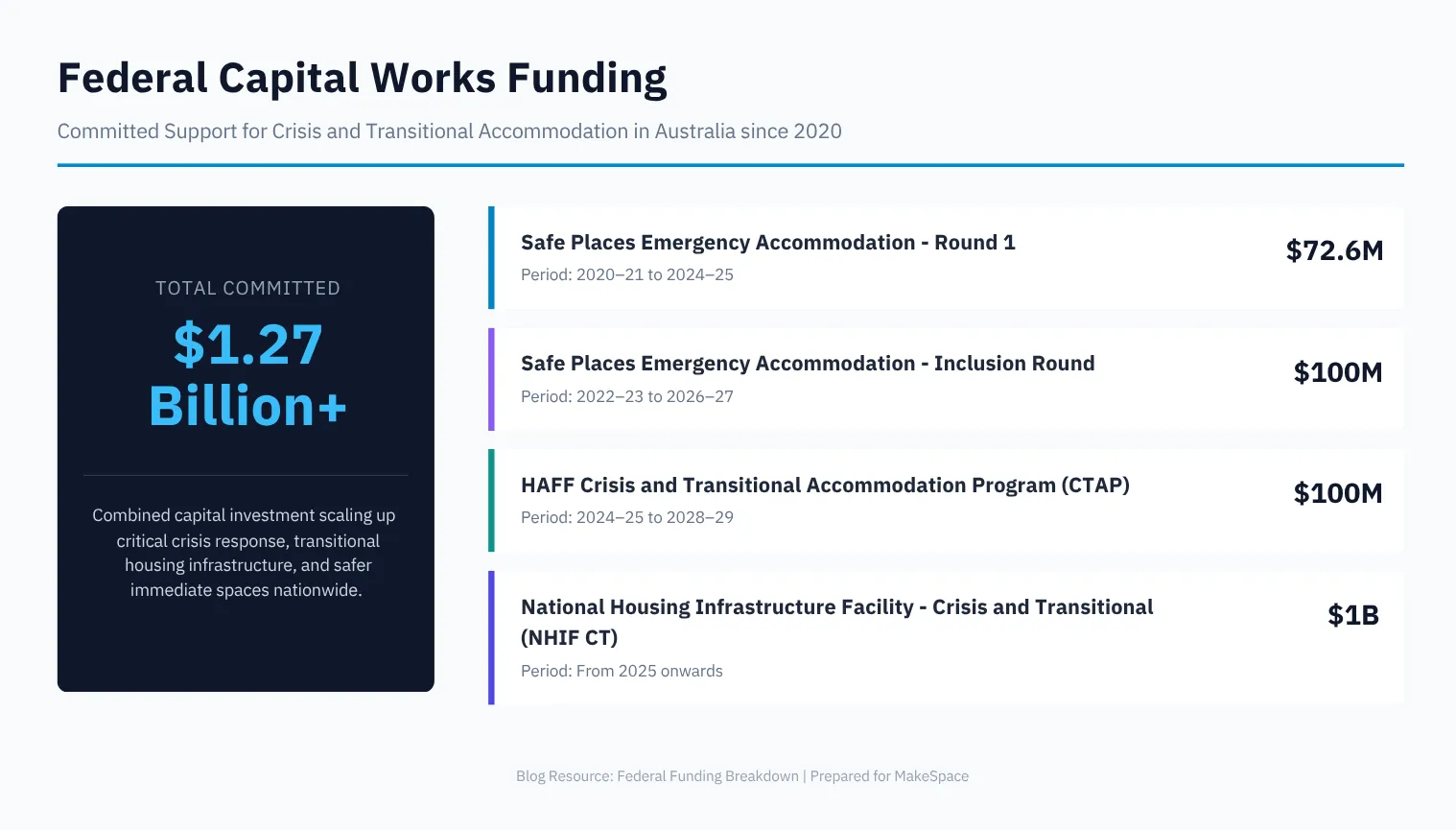
This is a sustained, policy-driven investment with defined target cohorts and clear delivery expectations. For not-for-profit housing providers and community housing providers (CHPs) with well-designed projects that meet the eligibility requirements, this represents a genuine opportunity to expand capacity in one of the most needed areas of specialised residential accommodation.
What are the three main federal funding programs for crisis and transitional accommodation?
All three major federal programs are property development and capital works (CAPEX) funding only. They cover the building, purchase, or re-modelling of facilities - not the ongoing costs of running them. Providers need to secure service delivery funding separately, typically through state and territory government agreements.
Here is how the three programs compare:
A note on the NHIF CT name change: Housing Australia has renamed NHIF CT to "HAFF – Crisis and Transitional" as part of a broader streamlining of its funding products. Existing contracts, EOIs, and applications under assessment are not affected. Both names may appear in current documentation.
Safe Places Emergency Accommodation Program
Established under the National Plan to Reduce Violence against Women and their Children 2010–2022 and continued under the 2022–2032 National Plan. Round 1 ($72.6 million) funded 40 projects delivering 234 dwellings and approximately 890 new safe places, now operating. The Inclusion Round ($100 million) is funding 19–20 projects delivering approximately 720 new safe places, with a focus on First Nations women and children, women with disability, and women from culturally and linguistically diverse backgrounds. Administered through the Community Grants Hub.
HAFF Crisis and Transitional Accommodation Program (CTAP)
Funded through the Housing Australia Future Fund. The first round funded 42 projects in February 2025 across all states and territories; 41 organisations are delivering them. Capital works only. The first round is now closed and next round timing has not been confirmed. Administered through DSS and the Community Grants Hub.
National Housing Infrastructure Facility - Crisis and Transitional (NHIF CT)
The largest of the three programs, with $1 billion available as a mix of grants (up to $700 million) and concessional loans ($300 million). Unlike the other two programs, it is demand-driven and not competitive. Applications are assessed as submitted, not ranked against each other. EOIs opened on 28 April 2025 via the Housing Australia Portal. Jurisdictional allocations applied until 5 January 2026; after that, unallocated funds are available nationally regardless of location. The program will remain open until all funds are allocated.
Who is eligible for crisis accommodation funding in Australia: community housing providers, not-for-profits, and more
Eligibility varies by program. Here is a summary:
Safe Places and CTAP
- Not-for-profit organisations
- State, territory, and local governments
- Trusts (if the trustee is an eligible entity type)
- For Safe Places: organisations that are not Family and Domestic Violence (FDV) specialists must demonstrate a formal, ongoing partnership with a specialist FDV or specialist Indigenous service
NHIF CT
- Registered community housing providers that are registered charities and constitutional corporations
- Local, state, or territory government-owned corporations that are constitutional corporations
- Entities with the primary purpose of improving housing outcomes for First Nations people, that are registered charities
- Joint delivery models are permitted. For example, a Special Purpose Vehicle between a registered CHP and an Aboriginal Community Controlled Organisation (ACCO)
- Note: CHPs must be registered charities to be eligible. This is explicitly stated in the NHIF CT Guidelines
For all programs:
- Projects must demonstrate additionality - a net increase in crisis or transitional housing supply (see FAQ below)
- Refurbishments that constitute ongoing maintenance are not eligible; significant refurbishment that creates additional supply may qualify
- Projects funded under NHIF CT must incorporate universal design principles, meeting at minimum the Liveable Housing Australia (LHA) silver standard or equivalent
What does a strong crisis accommodation funding application need?
For providers working in crisis and transitional accommodation, a funding application is not only a statement of need; it is evidence of delivery readiness. Funders are assessing whether the project can be built and operated as proposed, not just whether the need exists.
A strong application across all three programs will typically include:
- A clearly defined project scope: New build, acquisition, conversion, or significant refurbishment; what it will deliver and for whom
- Evidence of site control or site identification: Confirmed site ownership, lease, or heads of agreement; site constraints assessed
- Early housing project feasibility work: Cost estimates, program assumptions, and financial modelling that demonstrate the project is viable
- Evidence of demand and need: Data on the target cohort in the proposed location; alignment with local service gaps
- State or territory agency support: Required for NHIF CT; demonstrating government endorsement strengthens any application
- A service delivery model: Who will deliver support services, under what funding arrangement, and how residents will be supported
- A design approach: Evidence of trauma-informed design principles and universal design standards where required
- Project risk management: Identified risks and how they will be managed through delivery
Housing project feasibility and project risk management are part of the funding process. Funders assessing value for money want to see that capital investment is going into projects that are viable, well-governed, and ready to deliver.
Our blog on the difference between a feasibility study and a business case covers how to structure this thinking before entering an application process.
Capital funding vs operational funding in crisis accommodation: what providers need to understand
This is the most important distinction for any provider navigating this funding landscape.
Capital funding covers the cost of building, purchasing, or converting a facility. All three federal programs described above are capital works funding only.
Operational funding covers the ongoing cost of running the service. Staffing, utilities, maintenance, and the support services that make crisis accommodation function as intended. This is funded separately, through state and territory government service agreements, typically under the National Housing and Homelessness Agreement (NHHA) between federal and state governments.
The gap between these two funding streams is where delivery risk sits. A provider can receive capital funding to build a facility and still not be able to open it if ongoing operational funding has not been secured (i.e. can build it, but can’t afford to keep the doors open). This is a documented challenge in the sector, and it is one of the reasons housing governance and financial planning need to be in place well before construction begins.
The practical implication for project planning:
- Confirm operational funding pathways at the feasibility stage, not after the build
- Engage with your state or territory housing department early to understand what service agreements may be available
- Model both capital and operational costs in your housing feasibility study before submitting a funding application
- Understand that affordable housing and social housing funding streams are separate from crisis accommodation operational funding, as they serve different parts of the housing spectrum
How MakeSpace supports crisis and transitional accommodation delivery: from feasibility to handover
The organisations working in crisis and transitional accommodation carry deep expertise in care, casework, and trauma-informed support. What they often need alongside that is structured housing project delivery support - someone who understands what it takes to move a project from a funding application through to a building that is ready to open.
MakeSpace works with not-for-profit housing providers, community housing providers, and mission-driven organisations delivering crisis and transitional accommodation, from early feasibility and housing advisory services through to procurement, construction oversight, and handover. That includes the project planning and governance work that underpins a strong funding application, as well as the accommodation delivery discipline needed once capital is committed.
The starting point is always the same: understanding what the provider is trying to achieve, and what the people walking through the door will need from day one. The delivery follows from there.
If your organisation is working toward a funding application for crisis or transitional accommodation and would find it useful to talk through the delivery and feasibility considerations, we welcome that conversation.
For broader context on what crisis accommodation is and who it serves in Australia, our blog on crisis accommodation in Australia covers the sector in full.
Frequently Asked Questions (FAQs)
Is crisis accommodation funding available for organisations that are not domestic violence specialists?
Under the Safe Places program, organisations that are not FDV specialists can apply, provided they demonstrate a formal, ongoing partnership with a specialist FDV service or specialist Indigenous service. Under the NHIF CT, eligible applicants are not required to be FDV specialists, but projects must target the specified cohorts - women and children experiencing family violence, and older women or youth experiencing or at risk of homelessness. For all programs, demonstrating clear alignment between the organisation's service model and the needs of the target cohort is essential.
Can Aboriginal Community Controlled Organisations access crisis accommodation funding?
Yes. Entities with the primary purpose of improving housing outcomes for First Nations people that are registered charities are eligible for NHIF CT funding. Joint delivery between a registered CHP and an Aboriginal Community Controlled Organisation (ACCO) is also permitted, for example, through a Special Purpose Vehicle. According to the NHIF CT FAQs, Housing Australia encourages applicants to identify how their project will benefit First Nations people and how it will be delivered in a culturally appropriate way, particularly where service provision involves an ACCO.
What is additionality and why does it matter for funding applications?
Additionality is the net increase in crisis or transitional accommodation supply that a project delivers. All three federal programs require this - funded projects must create new places, not simply maintain or refurbish existing stock. A project that undertakes significant refurbishment of 20 existing dwellings and adds 10 new ones would typically satisfy the requirement; routine maintenance of existing stock would not. This requirement exists to ensure that public investment expands the total supply of safe places available to people who need them.
Can the same project receive funding from more than one program?
This is not explicitly prohibited, but each program has its own eligibility and assessment criteria, and applications are assessed on value for money including the depth of subsidy required. Providers should check with the relevant administering body (DSS for CTAP and Safe Places, Housing Australia for NHIF CT) before applying to multiple programs for the same project. Early engagement with Housing Australia is actively encouraged; pre-EOI meetings can be booked through the Housing Australia Portal ahead of submitting an EOI.
Sources: DSS - CTAP Grants for Crisis and Transitional Accommodation; Housing Australia - NHIF CT Program; Housing Australia - NHIF CT Program Guidelines March 2025; Housing Australia - NHIF CT FAQs; DSS - Safe Places Emergency Accommodation Program; Treasury - Safe Places Program; AIHW - Specialist Homelessness Services Annual Report 2024–25
Last updated on June 14, 2026
Get in touch
Ready to deliver housing that makes a real difference? We'd love to discuss your project.


