
By Samantha Ace, Development Director, MakeSpace | Housing advisory and project delivery for community, affordable and specialised housing providers
Crisis accommodation is short-term, supported housing for people who have nowhere safe to go, including those fleeing domestic violence, people experiencing homelessness, and young people without stable housing. In Australia, it sits at a critical point between homelessness and the longer-term housing system, and is almost always delivered alongside support services rather than as housing alone. For the organisations building and operating it, it is less a housing product and more a service - one that exists to give people enough safety and stability to take a next step forward.
What is Crisis Accommodation and how does it differ from Social Housing and Transitional Accommodation?
Crisis accommodation, emergency accommodation, and transitional accommodation are related but distinct.
Here is how they sit within the broader housing spectrum:
Crisis accommodation is the entry point for people at the sharpest end of that spectrum. Transitional accommodation bridges what comes next. It is less about immediate safety and more about building routines, accessing support, and taking steps toward independent housing.
Both are distinct from social housing and community housing, which provide long-term rental tenure rather than short-term crisis response.
Crisis accommodation is the gateway between homelessness and stable housing. It rarely operates in isolation. Wrapped around it is a range of support services designed to help people stabilise, recover, and move toward longer-term housing.
What makes crisis and transitional accommodation one of the most demanding forms of specialised residential accommodation to deliver is that it is a service, not a product. Providers are not collecting market rent. The model is funded by government precisely because it serves people who cannot access or afford private housing. The built environment, the support services, and the delivery quality all need to work together from day one.
According to AHURI Final Report No. 407 — Crisis accommodation in Australia: now and for the future, models in Australia range from refuge-style congregate services to small-scale units, transitional apartments, and purchased beds in hotels or rooming houses. What they share is the intent: to provide a safe place while people find their footing.
Who uses crisis accommodation in Australia?
The people who need crisis accommodation are not a single group. According to the AIHW Specialist Homelessness Services Annual Report 2024–25 and the Australian Homelessness Monitor 2024, the key cohorts include:
- Women and children fleeing domestic and family violence: The single largest group, accounting for over 40% of all specialist homelessness services clients in 2024–25
- People experiencing rough sleeping: Rough sleeping increased by 22% in the three years to 2023–24
- Older Australians: One of the fastest-growing cohorts; those aged 55–64 up 15% and those aged 65 and over up 31% over six years
- Young people: Particularly those ageing out of the out-of-home care system, who can face homelessness from the day they turn 18
- First Nations Australians: Significantly overrepresented among people seeking homelessness support
- People leaving institutions: Including hospital, prison, or mental health settings, without stable housing to return to
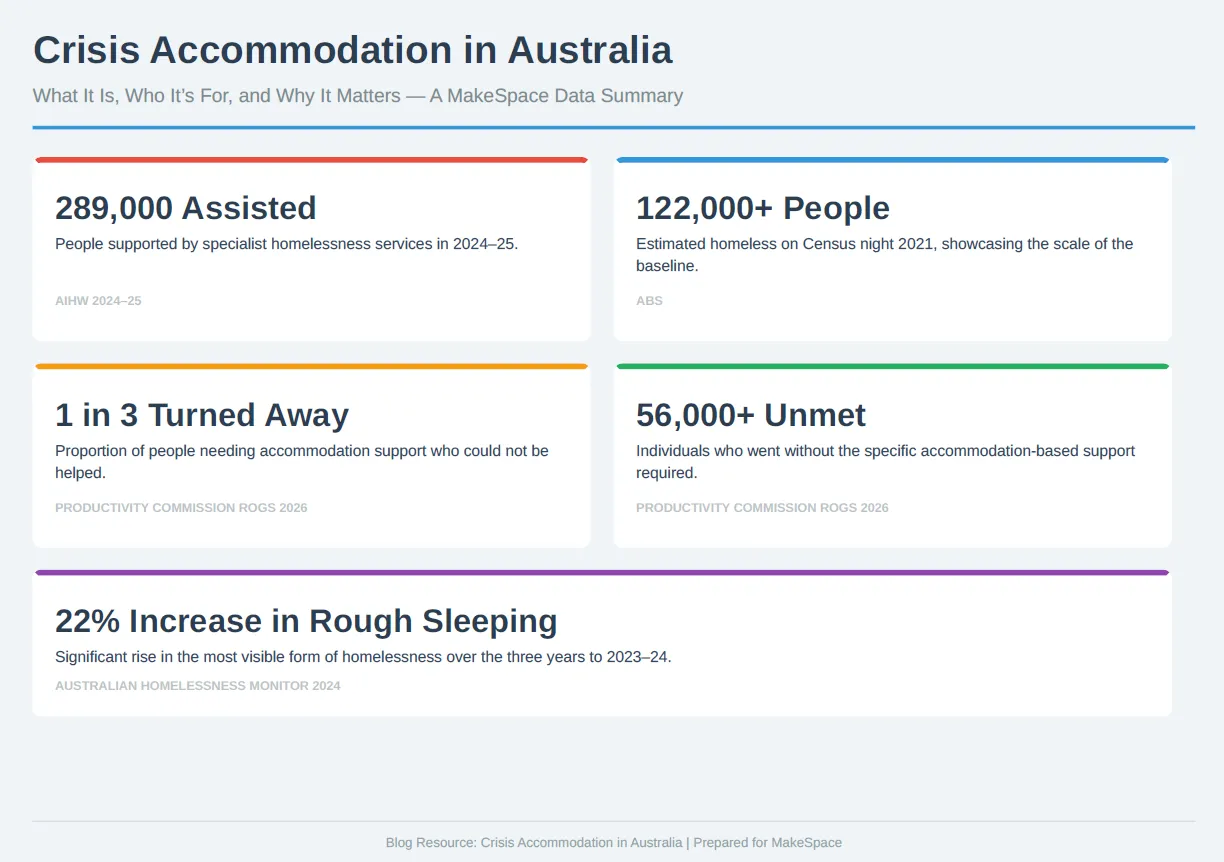
Housing insecurity is no longer confined to those who have historically been most at risk. It is reaching people who, not long ago, had stable housing and stable lives.
In Victoria, The Cocoon, delivered through a partnership between Bridge It and Housing First, is a strong example of transitional accommodation responding to a specific cohort. Opened in October 2024, the St Kilda property was transformed into 16 self-contained apartments for young women and gender-diverse people aged 17 to 21 leaving out-of-home care. On-site support, peer mentoring, and clear pathways to employment and longer-term housing are built into the model from the outset.
What does crisis and transitional accommodation look like in practice?
There is no single model. Services range from women's refuge facilities and domestic violence shelters with specialist on-site support, to small supported housing units, shared transitional apartments, and emergency beds in converted or repurposed buildings.
Organisations like Mission Australia, the Salvation Army, and Red Cross provide referral, casework, and in many cases, accommodation directly. Their work extends well beyond providing a bed. It includes safety planning, counselling, legal and financial assistance, connections to health services, and practical pathways to longer-term housing.
What the built environment needs to deliver:
- Private rooms rather than dormitory-style shared spaces
- Lockable storage for residents' personal belongings
- Strong acoustic privacy between rooms and communal areas
- Discreet entry points that protect resident safety and confidentiality
- Calm, well-lit communal spaces that feel domestic rather than institutional
- Resident-only zoning with clear incident response routes
- Trauma-informed design - spaces planned around the needs of people who have experienced violence, instability, or loss
- Where possible, space for pets - the threat of being separated from their pets leads many people to remain sleeping rough in order to maintain this essential connection
Research published in the International Journal of Environmental Research and Public Health on trauma-informed design in supported housing confirmed that the built environment has a meaningful impact on residents' sense of safety and their capacity to stabilise and recover. These design features are not aspirational, they are part of what makes a crisis service effective.
Federal government investment in this sector:
In February 2025, 42 projects were funded under the CTAP across Australia. All are expected to be delivering services by 30 June 2029.
Why is crisis accommodation delivery so challenging for not-for-profit housing providers?
The funding is there (albeit limited). The need is clear. Yet, accommodation delivery in this sector remains genuinely difficult, and the reasons are structural.
1. It is a service model, not a rental model
Crisis accommodation providers do not generate revenue through market rent. Government funding is the primary income source, which shapes feasibility, cash flow, and long-term financial planning from the outset. CTAP grants, for example, cover capital works only. Providers must separately secure funding for maintenance and ongoing service delivery, which requires its own governance, planning, and accountability structures.
2. Delivery capability is often limited
Most organisations working in this space are not-for-profit housing providers with deep expertise in care, casework, and support, but limited in-house project delivery capability. Managing feasibility, design, procurement, construction, and handover is a different discipline. The delivery risk is real: a project that stalls, runs over budget, or opens with unresolved defects has consequences that go beyond the financial. The people who were meant to be housed are still waiting.
3. The building and the service cannot be separated
A facility that meets minimum compliance standards but is poorly designed for the people using it, with inadequate acoustic privacy, disorienting layouts, or spaces that feel institutional, will underperform regardless of the quality of the support services inside it. Housing governance and delivery quality matter here in ways that are directly felt by residents.
According to the Australian Homelessness Monitor 2024, 77% of homelessness services found it significantly harder to secure housing for clients in mid-2024 than the year before. The average duration of support rose 44% over five years as people stayed longer because there was nowhere for them to move on to. When someone moves further along the spectrum, from crisis accommodation toward rough sleeping, the pathway back is harder and longer. Getting the delivery right the first time matters.
For a broader view of how handover fits into the delivery process and why it is especially important where re-entry after occupancy is limited, our blog on residential care and specialised accommodation handover covers this in detail.
How MakeSpace supports crisis and transitional accommodation delivery
The organisations doing this work - not-for-profit housing providers, community housing providers, and specialist accommodation operators - carry the expertise in care and support that these services depend on. What they often need alongside that is structured project delivery support: someone who understands what it takes to get a building from feasibility to handover, and who knows the particular demands of this sector.
MakeSpace works in crisis and transitional accommodation alongside these providers, from early planning and procurement through to commissioning and handover. That includes:
- Spaces designed for casework and partner services
- Layered safety planning built into the design from the outset
- Trauma-informed environments with appropriate acoustic privacy and resident zoning
- Thoughtful specifications that balance durability with warmth
- Thorough handover and commissioning processes so that buildings open ready to serve the people they are built for
The starting point is always understanding what success looks like for the provider, and for the people who will walk through the door. The delivery follows from there.
For context on how crisis accommodation fits within Australia's broader housing landscape, our blog on social, public, community and affordable housing sets out how the different parts of the system connect.
If your organisation is planning or developing a crisis or transitional accommodation project and would find it useful to talk through the delivery considerations, we would welcome a conversation.
Frequently Asked Questions (FAQs) About Crisis Accommodation
What is the difference between crisis accommodation and transitional accommodation?
Crisis accommodation is immediate, short-term housing (typically days to a few weeks) for people who have nowhere safe to go. Transitional accommodation bridges the gap between crisis and longer-term housing, usually lasting weeks to months, and is designed to provide stability while a person works toward a more permanent solution. Both are almost always delivered alongside support services including casework, safety planning, and pathways to longer-term housing. They are distinct stages of the same journey, and both need to be designed and delivered with that in mind.
Who funds crisis accommodation in Australia?
Crisis accommodation is primarily funded by state and federal government, because it serves people who cannot access or afford private rental housing. At the federal level, the Housing Australia Future Fund's Crisis and Transitional Accommodation Program (CTAP) committed $100 million over five years from 2024–25, funding 42 projects across Australia. An additional $1 billion was committed through the National Housing Infrastructure Facility in late 2024, supporting women and children fleeing domestic violence, young people at risk of homelessness, and veterans. Ongoing service delivery is funded separately.
Who provides crisis accommodation in Australia?
Crisis accommodation is delivered almost entirely by not-for-profit organisations, including community housing providers, specialist homelessness services, and mission-driven organisations such as the Salvation Army, Mission Australia, and Red Cross. These providers receive government funding to build, operate, and staff crisis services. They are experts in care, casework, and trauma-informed support - and often partner with specialist housing advisory and delivery organisations to manage the construction and commissioning side of new facilities.
Why does the design of crisis accommodation matter?
People accessing crisis accommodation have often experienced trauma, violence, or prolonged housing insecurity. The design of the built environment affects how safe and supported they feel. Private rooms, lockable storage, acoustic privacy, discreet entry points, and trauma-informed spatial design are not optional; they are part of what makes a crisis service effective. Research confirms that the physical environment plays a meaningful role in residents' sense of safety and their capacity to stabilise. A poorly designed building makes it harder for staff to support residents, and risks creating additional trauma.
Sources: AIHW — Specialist Homelessness Services Annual Report 2024–25; Australian Homelessness Monitor 2024, Homelessness Australia; Productivity Commission — Report on Government Services 2026; Housing Australia — NHIF Crisis and Transitional Housing Program; AHURI Final Report No. 407 — Crisis accommodation in Australia: now and for the future; DSS — HAFF Crisis and Transitional Accommodation Program; Housing All Australians — The Cocoon; International Journal of Environmental Research and Public Health — Trauma-Informed Design of Supported Housing
Get in touch
Ready to deliver housing that makes a real difference? We'd love to discuss your project.


