By Adrian Janiszewski, Senior Project Manager at MakeSpace | Housing advisory and project delivery for community, affordable and specialised housing providers
In Victoria, the planning system does not treat affordable housing as an optional add-on. It is embedded in the framework that guides how development decisions are made. Under Clause 71.02-3 of the Victoria Planning Provisions, planning decisions must deliver a net benefit to the community - now and for future generations. Affordable housing is one of the clearest ways a development can demonstrate that it does. For purpose-driven developers, community housing providers, and not-for-profit housing organisations, understanding how this framework operates is the starting point for using the Victorian planning system to achieve better housing outcomes.
What does affordable housing mean in Victoria's planning system, and who does it cover?
The Planning and Environment Act 1987 was amended in June 2018 to include a specific objective: to facilitate the provision of affordable housing in Victoria. This gave affordable housing formal policy weight in the planning system.
Under the Act, affordable housing covers housing that is appropriate for very low, low, and moderate income households. It includes social housing (public housing and community housing) but also extends to other income-tested housing that meets the eligibility thresholds set by the Governor in Council Order.
The Order, published annually in the Government Gazette, specifies the income ranges that define who qualifies. The current figures, from the Governor in Council Order 2025 (effective 1 July 2025), are:
The above figures apply to the Greater Capital City Statistical Area of Melbourne only. Lower thresholds apply in regional Victoria. The Order is updated annually; always refer to the current version for current figures.
These income bands matter practically. They define who a project must serve to qualify as affordable housing under the planning framework, which in turn shapes feasibility assumptions, rent-setting, and eligibility for planning incentives. Understanding local housing development demand against these income bands is also the foundation of any credible affordable housing proposal. Funders and councils will look for evidence that a project responds to genuine, documented need in its target location.
For context on how affordable housing sits within Australia's broader housing landscape alongside social housing, public housing, and crisis accommodation, our blog on Australia's housing spectrum sets out the full picture.
How does Victoria's planning policy framework support affordable housing and community housing delivery?
The Planning Policy Framework (PPF), comprising Clauses 10–19 of every Victorian planning scheme, is a single integrated policy source. Decisions are not made in isolation - they must be assessed against a cohesive set of economic, environmental, and social objectives.
Under Clause 71.02-3 of the Victoria Planning Provisions, planning and responsible authorities must balance conflicting objectives in favour of net community benefit and sustainable development for the benefit of present and future generations. Affordable housing is one of the clearest demonstrations of that benefit in a residential development context.
This is the core principle that gives affordable housing its leverage in the planning system. Where a development proposes affordable housing, it is not seeking a concession. It is making a measurable contribution to one of the framework's stated objectives.
The primary legal mechanism for securing affordable housing at the planning permit stage is a Section 173 agreement, a voluntary agreement made under the Planning and Environment Act 1987 between a responsible authority (usually the local council) and the landowner. The agreement is registered on the title, runs with the land, and can specify the affordable housing obligations the developer must meet.
For councils to request a Section 173 agreement, they need a strategic basis, typically identified in a local Housing Strategy that documents housing need, demand, and priorities for the area. This is important for housing governance: councils cannot request affordable housing contributions ad hoc; they need to have done the planning policy groundwork first. For community housing providers and not-for-profit housing organisations, understanding whether a council has this strategic foundation in place is a useful early step in any site assessment.
How are Victorian councils using affordable housing as a planning incentive for developers?
There is a growing pattern across Victoria of councils embedding affordable housing into their planning schemes, both as part of rezonings and as conditions on planning permit applications for significant developments.
One of the most common mechanisms is the use of building height as a lever. Where a developer seeks to exceed preferred or mandatory height limits, they may be required to demonstrate a net community benefit and affordable housing is explicitly recognised as a qualifying benefit by a number of councils. The Built Form Overlay (Clause 43.06), introduced under Amendment VC257, now provides a statewide public benefit uplift framework: height and other mandatory standards can only be exceeded where a public benefit, including affordable housing, is provided and secured by a Section 173 agreement.
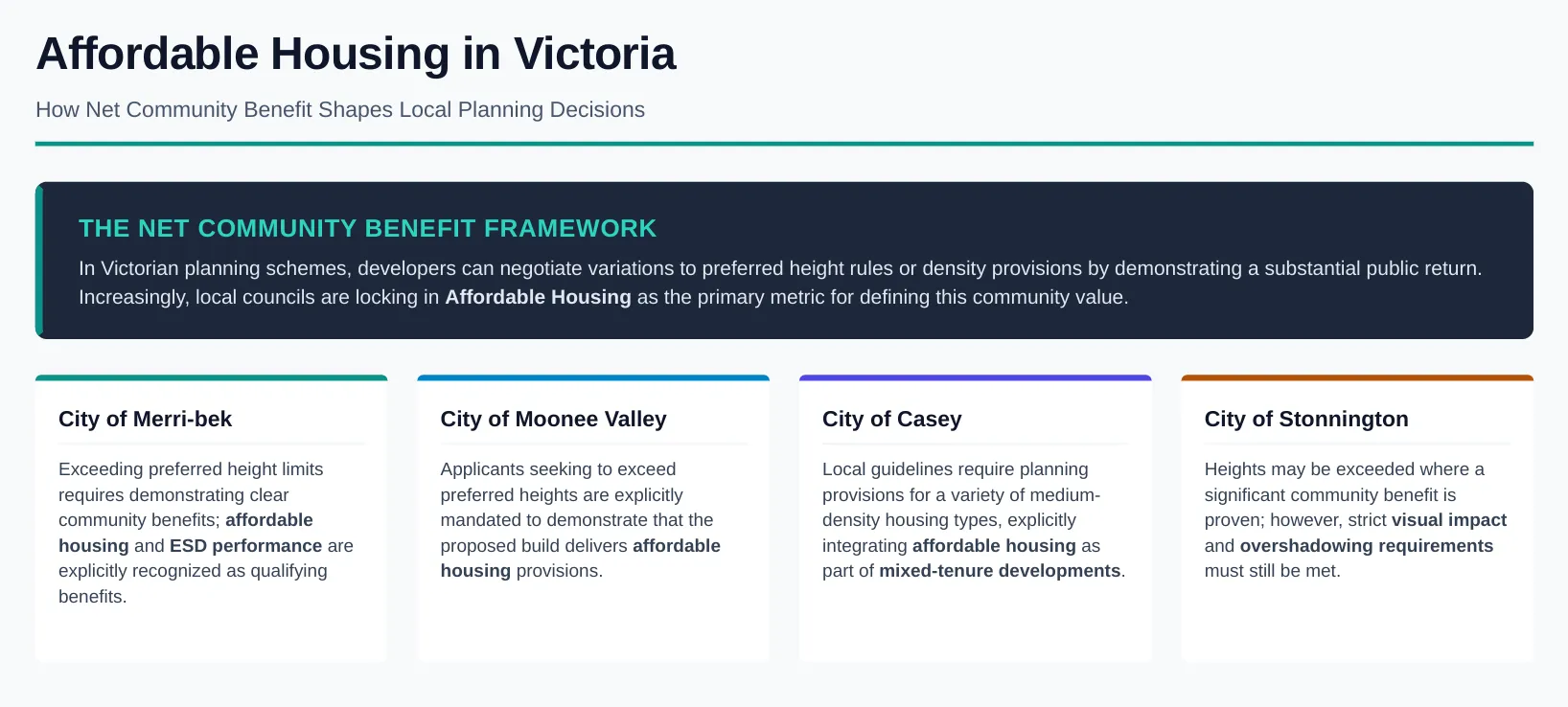
This pattern of trading planning incentives such as additional height or floor area for affordable housing outcomes reflects the net community benefit principle in practice. Developers gain additional commercial value; the community gains housing uplift that would not otherwise be delivered. For purpose-driven developers and community housing providers working in these areas, knowing which councils have established this framework is a useful starting point for site assessment and early engagement.
Victoria's Housing Statement: what it means for affordable housing supply and delivery
In September 2023, the Victorian Government released Victoria's Housing Statement - The Decade Ahead 2024–2034, setting a target of 800,000 new homes over a decade. This is a significant step up from approximately 57,000 homes per year delivered between 2016 and 2021.
The Statement links housing supply directly to housing affordability in Victoria: its central proposition is that more homes in more locations, closer to transport and services, will improve housing outcomes for low and moderate income households over time. Several major reforms flowing from it are relevant to affordable housing delivery:
- The Housing Choice and Transport Zone (Clause 32.10): Facilitates higher density residential development near activity centres and well-serviced public transport locations, with housing diversity as a core objective
- The Built Form Overlay (Clause 43.06): Enables public benefit uplift frameworks where a schedule to the overlay specifies it, including affordable housing contributions secured through Section 173 agreements; not all BFO-affected land will have this framework applied
- Clause 53.23 - Significant Residential Development with Affordable Housing: A new planning pathway for projects that commit to delivering at least 10% affordable housing (covered in detail in the second blog in this series)
- The Development Facilitation Program: Expanded to streamline planning approvals for residential developments that include affordable housing (also covered in the second blog)
The Consumer and Planning Legislation Amendment (Housing Statement Reform) Act 2025 received Royal Assent in March 2025, implementing key elements of the Statement into law. Victoria's planning environment for affordable housing is still evolving, and understanding project risk management within this changing framework is as important as understanding the framework itself.
The Big Housing Build sits alongside these reforms: a state government investment (originally announced at $5.3 billion and now grown to more than $8 billion) targeting more than 12,000 new social and affordable homes across Victoria, with more than 9,200 completed or commenced based on the 2024–25 Budget figures.
How MakeSpace supports affordable housing project delivery for community housing providers and purpose-driven developers
Understanding the planning framework is only the first step. Getting a project from planning approval to delivery - on budget, on program, and to the standard a community deserves - is where most of the complexity sits.
For community housing providers, not-for-profit housing organisations, and purpose-driven developers working on affordable housing in Victoria, that complexity includes housing project feasibility assumptions that need to hold up under scrutiny, procurement decisions that account for the realities of the current construction market, and delivery risk that begins the moment a planning approval is granted, not after it.
Affordable housing projects are among the more complex forms of specialised residential accommodation to plan and deliver, precisely because they sit at the intersection of planning policy, funding structures, income eligibility requirements, and community expectations. Getting those elements aligned, and keeping them aligned through design, procurement, and construction, is where experienced housing advisory services make a practical difference.
MakeSpace works with community housing providers, not-for-profit housing organisations, and purpose-driven developers on affordable housing projects in Victoria, from early site assessment and housing project feasibility through to procurement, construction oversight, and handover.
If you are at the early stages of a project and working through what a feasibility study should include before committing to a planning pathway, our blog on the difference between a feasibility study and a business case covers this in detail.
If your organisation is navigating the Victorian planning system for an affordable housing project and would find it useful to talk through the delivery considerations, we would welcome that conversation.
Frequently Asked Questions (FAQs)
What is net community benefit in Victorian planning?
Net community benefit is the principle under Clause 71.02-3 of the Victoria Planning Provisions that requires planning and responsible authorities to balance all relevant planning policies and objectives in favour of outcomes that benefit both current and future generations. When competing objectives arise, for example, building height versus neighbourhood character, the decision must weigh which outcome delivers the greatest overall benefit to the community. The provision of affordable housing is one of the most direct and measurable contributions a development can make toward this benchmark.
Is affordable housing a mandatory requirement in Victorian planning schemes?
Victoria's approach remains largely voluntary rather than mandatory. Section 173 agreements, negotiated between councils and developers, are the primary mechanism for securing affordable housing at the planning permit stage. Councils need a strategic basis, typically a Housing Strategy, before requesting one. Some overlays, including the Built Form Overlay, now include explicit housing uplift frameworks. Developments accessing the residential pathway of the Development Facilitation Program under Clause 53.23 are required to deliver at least 10% affordable housing. This is one area where delivery is a precondition, not a negotiation.
What is a Section 173 agreement and how does it relate to affordable housing?
A Section 173 agreement is a voluntary legal agreement under the Planning and Environment Act 1987 between a responsible authority, usually a local council, and a landowner. In the context of affordable housing, it is used to formalise the delivery obligations a developer commits to as part of a planning approval. The agreement is registered on the title of the land and runs with the land on any future sale. For a council to request one, it needs a clearly established strategic basis, typically documented in its Housing Strategy. Planning Victoria provides example agreements to assist with negotiations.
How does affordable housing connect to building height allowances at a local level?
Several Victorian councils use preferred or mandatory building height limits as a lever for affordable housing delivery. Where a developer seeks to exceed a height limit, they may be required to demonstrate a net community benefit, and affordable housing is explicitly recognised as a qualifying benefit in councils including Merri-bek, Moonee Valley, and Stonnington. This is not automatic - each planning permit application is assessed on its merits, but it creates a practical pathway for developments that are prepared to commit to affordable housing outcomes in exchange for additional floor area or height. The Built Form Overlay has now formalised a version of this mechanism at a statewide level.
Last updated on June 14, 2026
Get in touch
Ready to deliver housing that makes a real difference? We'd love to discuss your project.


